Teaching with a blank grid
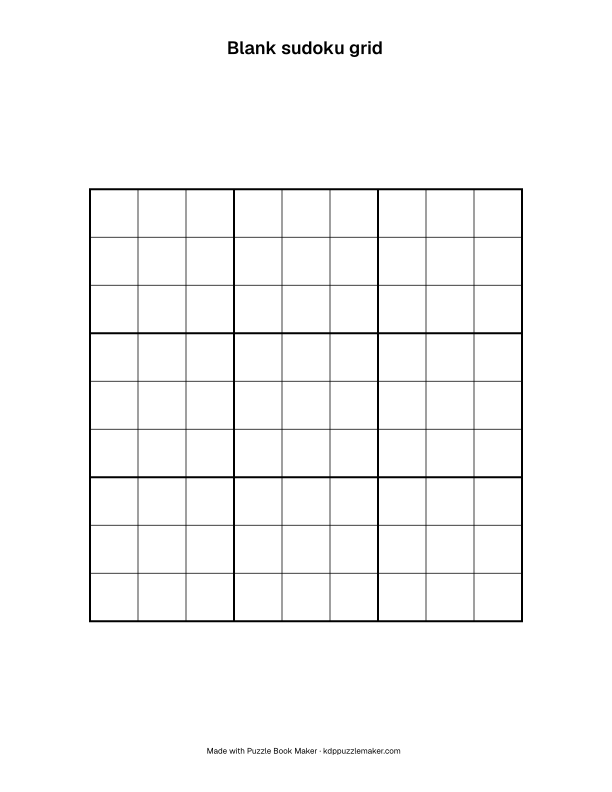
An empty grid is the clearest way to show how sudoku works. Draw a few digits into one box
and ask where the missing ones could go; then add a row and a column and watch the choices
shrink. The thick lines (2 pt, against
0.75 pt for the cells) make the boxes easy to see from the back
of the room. Once the idea lands, hand out a sheet of
easy sudoku printables to practise on.
A blank grid also helps with the step that trips up most learners: checking a digit.
Write a digit in pencil, then trace its row, column and box with a finger to make sure it
appears nowhere else. Repeating that a dozen times on an empty board builds the habit
before the pressure of a real puzzle.
Copying or writing a puzzle
Found a puzzle in a magazine you’d rather not write on? Copy its givens onto a blank grid
and keep the original clean for someone else. Setting your own puzzle is harder than it
looks: place givens one at a time and solve as you go, so you know a single answer still
follows. A puzzle with two solutions frustrates whoever solves it.
Games for a group
- Pass the pencil. Two players take turns placing a digit on one shared grid; whoever
breaks a rule loses the round.
- Same givens, many grids. Read out a puzzle’s givens and have everyone write them into
their own grid, then race to finish.
- Spot the mistake. Fill a grid with one deliberate error and see who finds it first.
Printing blank grids
Pick Letter or A4 to match your paper and print at actual size, so every square stays the
same size from sheet to sheet. Thin card takes pencil and an eraser better than copier paper
if a grid will be used again and again, and a laminated grid works with a dry-wipe pen.
The sudoku printables page has ready-made puzzles at every level when
you want something to solve rather than build.